Thursday, January 2, 2014

15. Monkey Business

Preah Phnom Udong (Udong Chedi(e) and Temple District)

120 km


I needed to get out of the city this morning and I thought the motorcycle would appreciate a little exercise as well. It was sitting already for too long now (4 days). I emptied the aluminum panniers and only took the air compressor and the tire repair tools with me.

The destination was Udong, the former capital of the Khmer Kingdom. As the capital it was called Oudong Meanchey; Oudong means 'noble' or 'superior', and 'Meanchey' means victory. Since the Siam Kingdom regularly invaded the area around the former Khmer capital Longvek, the seat of monarchy and Khmer power was moved to here. From 1618 until 1866 it was home to a succession of Khmer kings..

To get to Udong one doesn't need GPS, really. National Road No. 5 follows the Tonle Sap river to the north, and only a few turns and a steep climb up the mountain gets you to the ancient temples, hidden in the dense, otherwise impassable forest.

'National Road No. 5' sounds heroic, the road however, has stretches which are very bad, some construction makes the ride bumpy, dusty and difficult; it seems that they are preparing the highway to be widened. One has to keep the eyes wide open, as usual here. I also wished that the garment laborers wouldn't have been on strike again, since where this is the case the road is blocked and the entire traffic in and out of Phnom Penh goes through narrow alleyways of villages, literally through peoples backyard. Everything takes a while, but it is what it is.

The temple district, also briefly featured in Matt Dillon's movie 'City of Ghosts' is very remote and devoid of any tourism, foreign or local alike. On weekends, however, local people come here in hordes, I was told. It is a holy site and the Khmer spend the day at the bottom of the hills, spreading out on the wooden sleeping platforms. or in hammocks, eating and chatting with friends; the physically more fit climb the staircases to the top. The view from here over the Kandal plains is spectacular.

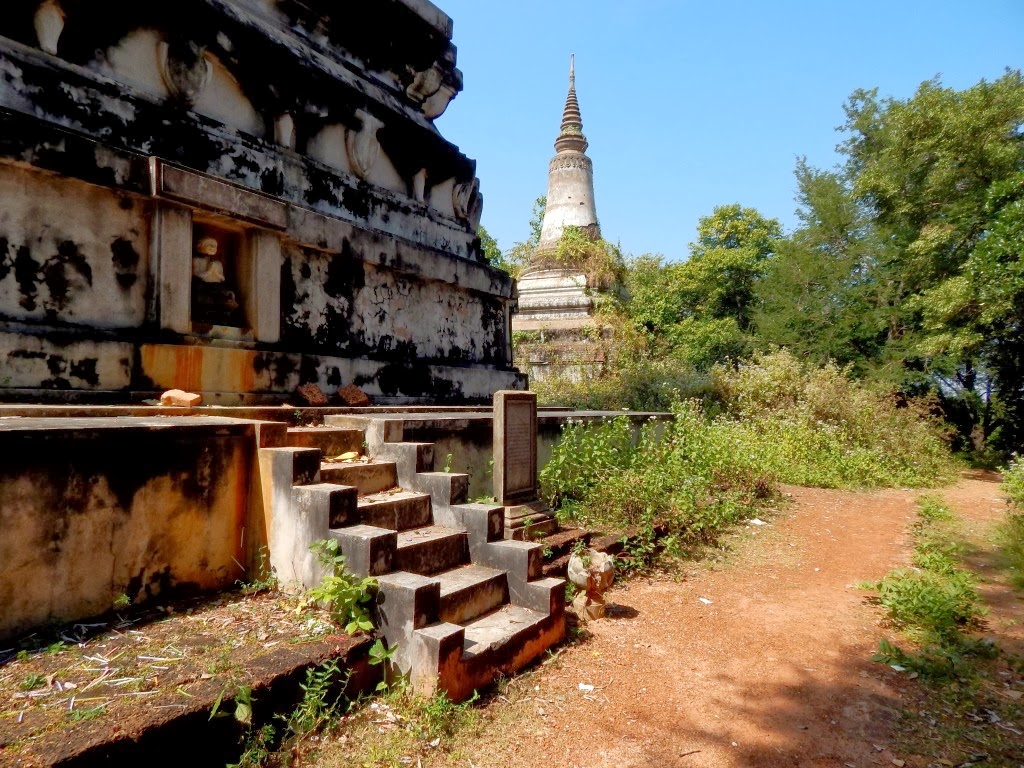


Compared to the noise of the capital Phnom Penh it is very quiet up here, even in the daytime, and all of a sudden I could here the unusual sound of a muffler of a big motorcycle in the distance. One is sensitized to sounds like that since the mosquito-like humming of the typical scooter swarms is all what can be heard otherwise. I thought by myself that since there isn't really another destination for somebody on a big motorcycle I just wait and see who is coming.

And here they came: A fantastic KTM 990R, and on it Dave, an American missionary from Colorado and his mother-in-law who is visiting from the States!


Monk, and Dave from Colorado on a KTM 990R, in the monastery.


The soft drink vendor family.


The excellent German HEIDENAU tires. Now, that's a tire you can try to find in Cambodia!
Dave has contacts to car importers. They typically load four used cars into a shipping container, wheels off, resting on 2x6 scaffolding. In the trunks one can ship motorcycle tires from the U.S..


Dave lives in Cambodia since the early 1990s, works mainly with medical support teams for remote villages, speaks fluent Khmer, and knows pretty much all the dirt- and other roads in this country. The KTM is his 'Company car', he says. I like that! He puts about 900 km per month on average on the bike, travelling the remote countryside from village to village. 

We were talking a lot, looking at maps and figuring out my upcoming trip to Siem Riep/Angkor, and had fun. His story how he purchased the KTM in California and shipped it over here was amazing, yet lengthy, and I will not post it here.

The temples and surrounding forests are basically owned by hundreds of wild monkeys who roam about, playing, fighting and eating, in other words behaving just like humans. Below I post some images of the amazing creatures.


Got to check the trash.


QUICK UPDATE IN REGARDS TO TRAFFIC IN THAILAND

The so-called "Dangerous Week", the New Year 7-day holiday in Thailand has claimed so far (on its 6th day) 334 lives in traffic, with motorcycle casualties being at the top of the list. Thailand is just a little larger in size than California; in less than one week one third of Chicago's annual traffic deaths have been recorded (2008: 1,043.)

Wednesday, January 1, 2014

14. Architecture in Phnom Penh under the French Protectorate 1867-1949

A French city in Southeast Asia


The city plan of Phnom Penh is a product of French urban planning. Here are the well-organized city grids, known from French cities, such as Paris, varied in design, from circular to rectangular with interesting overlaps, and there are the generously sized round-abouts all over Phnom Penh. And there is the beautiful "Croisette"-style river promenade (Nice, Cannes, France). Even if all the remaining historic buildings of the French period would fall victim to the current real-estate gold-rush one can sense in this town, the urban design will forever be a reminder of French planning.

The French protectorate was established against the will of the Khmer, but King Norodom had not much choice in view of the French gun boats anchored at the Tonle Sap river in front of his palace. He was raised in a country which was in essence divided up between Siam (Thailand) and Vietnam, and France was just about to establish French Indochina, forcing Cambodia into a union with Laos and Vietnam.

The French organized the city in largely three sectors: 1. French quarter to the north, Chinese in what's called BKK, in the center, and Khmer in the outskirts. The goal was to be separate from the Khmer.

The Chinese influence in the city was always very strong, descendants of Chinese families ruled, and still rule, large segments of the economy. In historic times they also controlled the very lucrative opium trade. The French authorities tried to established an own opium monopoly to take influence away from ethic Chinese. The attempt was only partially successful. 

The increasing demand for rubber by the growing automotive sector in the West established and boosted an early French dominance in the automotive sector (MICHELIN). Large plantations were built in Cambodia, and rubber was one of the major exported goods.

The examples of French-designed buildings are impressive, however their preservation  seem to be low on the local authority's 'To-Do'-list. Some of them are in dire need of restoration or else they will be lost in the very near future (Police Commissariat). Here are some of the prominent examples.

Hotel Internationale, Street 13, (approx. 1895, Architect: Unknown).
The street is known as the "Protectorate street". Not much has changed visually.


Chinese-Khmer residence (c.1915)
Sothearos Boulevard, opposite National Museum, now houses UNESCO headquarters.

Chinese-Khmer residence

Chinese-Khmer residence, Detail parapet.


Unknown. Sothearos Boulevard.


National Sports Complex (Olympic Stadium) (1964)
architects: Vann Molyvann & multi-national team

Olympic Stadium


Olympic Stadium, cantilevered concrete shell, span approx. 12 meters.

Olympic Stadium


Vann Molyvann's fabulous 1964 design of the Olympic Stadium is encroached by a real estate extravaganza of several tall residential and commercial towers currently under construction. The Korean developer managed to acquire large portions of the former Olympic park green space surrounding the stadium; when completed, the stadium itself will sit cramped, without the necessary space to breath, inside of this new complex. On a sign in front of the sales pavilion, the developer calls it: "Miracle of Phnom Penh." Well, maybe.


French residence, today office building (1960s, Architect unknown)


Tonle Sap river, at the junction with Mekhong river.


Tan Bunpha Chinese merchant residence, Sisowath Quai


Tan Bunpha residence.
http://www.chinesehouse.asia/index.html


Directorate of Rubber, Architect unknown.

Chaktomuk  Conference Hall, Architect: Vann Molyvann (1961)

Former "Manolis Hotel", once the only luxury hotel in Phnom Penh. Houses today some 30 families.
Former Postes et Telegraphes (French Central Post Office, 1895) Architect: Daniel Fabre. The square in front is unofficially known as the "Postal Square" and represents the heart of the French quarter.


Central Post Office


Central Post Office


Central Post Office

Central Post Office


Colonial Police Commissariat. Corner of Street 13 and 98, French Quarter. (1892)
"Hotel Belleville" in Matt Dillon's "City of Ghosts"

The building, which was built in 1892 and served as the colonial police force’s headquarters in Phnom Penh, has been mostly derelict for decades. The building is known for its role as the guesthouse run by Jacques Depardieu’s character in Matt Dillon’s 2002 crime drama City of Ghosts (PPP, Bennett Murray).


Colonial Police Commissariat

Colonial Police Commissariat

Colonial Police Commissariat


Maybe the 2002 movie "City of Ghosts" with Matt Dillon and Gerard Depardieu is not the greatest movie ever filmed but it is still worthwhile seeing (Matt Dillon should stay with acting, as a director he is pretty worthless, IMHO). I like it because of the sites and atmosphere of a gone-by era in Phnom Penh (one that I still remember), and because my friend Bernie plays a small role as an unscrupulous French expat villain.


Banque de l’Indochine (1890s/1930s)
5 Street 102, now houses Van’s Restaurant.

Tan Pa residence (1923)
Street 114, now houses Maybank Bank


Tan Pa residence (1923)

Tan Pa residence (1923)

1950s residence, Sihanouk Boulevard. Architect unknown.


Huynh Tho residence (1920s) , Corner Norodom Boulevard, Street 178. Formerly Embassy of japan, now private.
Architect: unknown

School, Sihanouk Boulevard.


Residence, Norodom Boulevard. Architect: Unknown.


The classic French concrete pavement tile, used all over the world where French administration ruled.


The Plantation Hotel, former French colonial administration building.  Restored in 2011 by ASMA Architects, Owner: Alexis de Surmain.


The Plantation Hotel