Monday, December 29, 2014

Sothy's Pepper Farm

In the foothills of the mountains bordering the coastal town of Kep, one can find several pepper plantations growing some of the best pepper in the world. The road system is strictly dirt tracks, the pavement ends at the main connector roads from Kampot to Kep, and then further on to Phnom Penh.

The hilly terrain, except for the plantations, is heavily forested. It amazes me to learn that up until the mid-1990s (!) the Khmer Rouge (KR) were still nestled into this remote jungle, fighting government forces who, ironically, were members of the KR previously, including their leadership.

I visit the Sothy farm, partly also because it is owned by a German man, married to a Khmer woman. They operate the plantation since some 20 years. During the off-season they employ four to six workers, during harvest, -they also grow durian fruit, Rambutan and Mango, whole villages are asked to come and help.

Pepper fascinates me since I was young, now I know a little more about it.

Caution! Driver-less train crossing.

Young pepper plants

The delicious green fruit, unripened

Shading made of bamboo


The manager. He has a Master's degree in agriculture from a university in Moscow, Russia.

Lime tree. Since this is a Eco-Certified organic plantation no insecticides are being used. Lime works as repellent.

Black, White, Red

Lime

Everything done by hand.


Bicycle water pump, if the diesel generator fails

Solar thermal water system, for showers and pepper washing and boiling.

Photovoltaic panels for 12 V generation fed into truck batteries

All rain water is being collected and re-used

Boiled black pepper dries in the sun.


Nice hut

Toilet and shower are outside


The farm grows the three different types of pepper common in the area: Black, Red and White. Green pepper, that means the fresh, unripened fruit directly from the plant, has such a short shelf life that it needs to be consumed no later than three days of harvest.

Red pepper has a skin, which can be removed by hand. After scraping the skin off, this pepper corn is white in color.

The black pepper is cooked fruit from the plant which subsequently is dried in large baskets in the sun.

The plants can reach a hight up to 10 feet, the lifespan is some 20 years after which new fruit trees are planted. It takes three years before they bear fruit.

All harvesting, sorting, washing is completely done by hand, there are no mechanical devices used at all. Good pepper is expensive, however if you see the hand labor going into the process it is surprising that it doesn't cost ten times as much.

A very pleasant morning in the forest.


Back in Kampot

Kampot, located in the province of the same name, some 3 hours south of Phnom Penh, isn't really a coastal town since there isn't any beach access. It belongs to the Top Ten of towns which I had a chance to see on my motorcycle tour over the past few month. I traveled, -and still do-, through three countries, Laos, Thailand and Cambodia, and had a chance to see diverse communities, from enchanting to dismal.

The list goes like this (In no particular order, I haven't made my mind up yet completely):

1. Kampot, Cambodia,
2. Mae Hong Son, Thailand
3. Chiang Saen, Thailand
4. Nong Kai, Thailand
5. Kep, Cambodia
6. Battambang, Cambodia
7. Siem Reap, Cambodia
8. Phnom Penh, Cambodia
9. Cha Am, Thailand,
10. Klong Yai, Thailand

The reason why Luang Brabang, Laos, didn't made the cut is simply that it is too overrun by Western tourist for my taste, at least. I am one myself, I know, but still.


Keep the dust at bay.


The local gas station


Preeak Taek Chhu River, Kampot

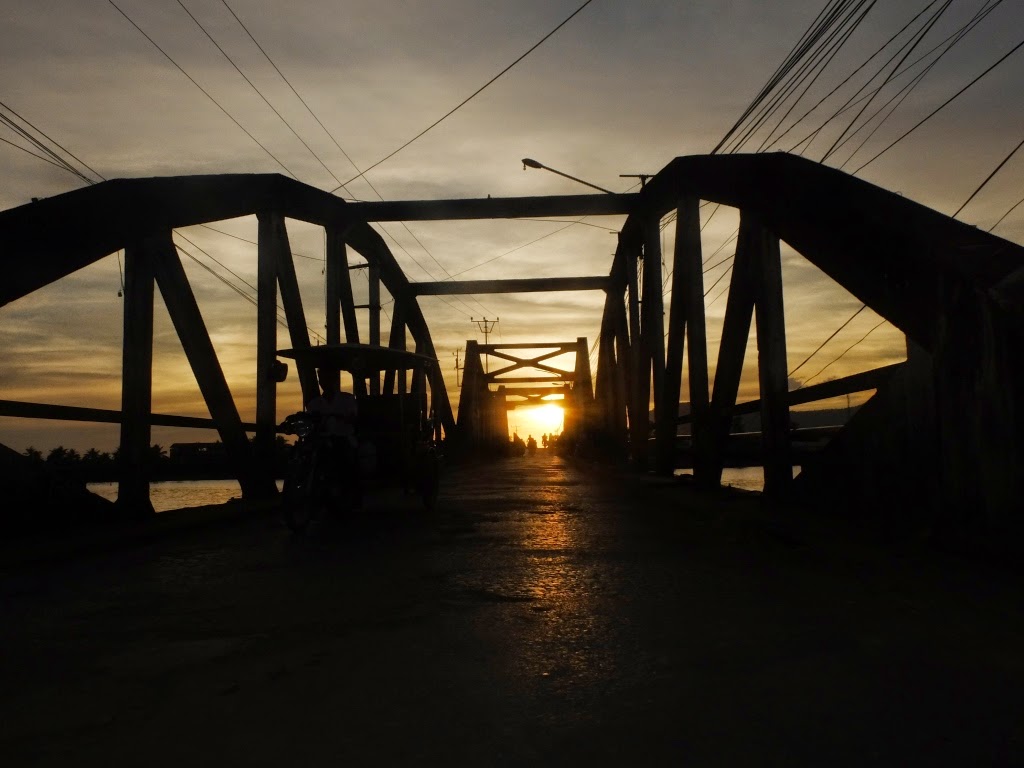
French-colonial build Entanou iron bridge

French-colonial built Market Hall, kampot


So now I am back in Kampot. It is just great to hang out here, not much to do, just watch the river go by, and the fishermen go out to sea at around 5 p.m. Here also much has changed. Formerly dismal dirt roads are now four-lane highways, many new buildings are gone up, and one sees many more foreigners, also ex-ptas, mainly from Europe and the U.S. But overall, this is still a rural fishing community, with no supermarkets or shopping malls, no chain stores, no large hotels, and no Western restaurants. And people still have to water the dirt road in front of their house if they don't want to be overwhelmed by dust. This is Cambodia!

I like it here very much.


Another example in my series of "Funky Cambodian Roundabout Sculptures"

And another one.

This might not look like much but it is the shop of the one-eyed lady Ms.Sokha, who is able to provide the best massage I have ever encountered.
I know her from a year ago.
The sensations she is able to evoke range from "heavenly bliss" to "pure and unapologetic, terrifying pain".
Ms. Sokha.

Below my hut.


Sunday, December 28, 2014

Tonle Bati Lake

Tonle Bati Lake is a very pleasant retreat for local Khmer folks; here they can escape the city fumes and noise and hang out in one of the little bamboo shacks which are built into the water. 

They are furnished with hammocks, mats and owned by a local family which rents them out. They bring you food and drinks as well. 


There is absolutely nothing to do except to watch the floating islands of water lilies and others species slowly float by, and the odd fisherman in his soundless canoe paddle by without making a wave or sound. It is fabulous.


Dara, the daughter of the owner of the hut.

Dara keeps the floating islands away from the hut.


I hang out in the hammock for three hours, Dara, the girl who rents me the hut, brings me two cokes, I invite her to one; she tells me of her family, that she doesn't like Khmer boys, about her sister and the English classes she takes; when I fall asleep she sneaks out without making a sound.


After a relaxing time I continue the ride down to the coast.


Traffic Rules

The traffic getting out of the city is just awful, sometimes I am just not in the mood for so much adventure, and I just want that everything runs smoothly, but that will never happen in this city.
For those of you who plan to ride a motorcycle in Cambodia here are gain the:

Rules, Regulations and Observations of Cambodian Traffic:

1.      There are no rules, the few which do exist are not obeyed. However, in case you intend to “Do-as-the Romans-do”, you will get stopped and fined. This is the way the poorly paid police force improves on their salary. The fines collected go directly into their pockets. Who would blame them.

2.      The rules that you as a ‘Barang” (Foreigner) have to follow are:

a)      Wear a helmet at all times (No Khmer rider wears one.)
b)      Do not ride with headlights turned on during the day. Riding at night WITHOUT lights is OK, though.
c)      Especially for US riders: Do not turn right on a red light.

The most important recommendations for riding are:

1.     Do not insist on your right-of-way.
2.      Traffic will enter from side streets without looking, and/or stopping.
3.      Scooter traffic won’t check rear traffic before executing U-turns, be prepared and HONK!
4.      Slow down to a crawl at intersections where you have a green light. Crossing traffic will not stop at a red light. This is for city driving, there are no intersections with traffic lights elsewhere.
5.      Pass people, cars, trucks and animals with a wide safety distance, especially at higher speeds on country roads.
6.      Watch for disabled vehicles on the road. They are marked by freshly broken-off tree branches. Watch especially for engine or transmission oil running across the road.
7.      Expect anything: Motorcycles, cars, trucks will come towards you in your own lane.
8.      And most importantly: Understand the pecking order in Cambodian traffic:

It is similar to a Totem pole, and you are at the bottom.

a)      At the very top are the cross-country busses, the big trucks and fuel tankers. If need be, you have to get off the road if they want to pass. They will not stop, especially at higher speeds;
b)      The next level down are the big SUV’s and bigger cars;
c)      Ten it is you on a big motorcycle. You will get some minor brownie points for riding a big points, but not many.
d)      Below you is everybody else: Dogs, pedestrians, and bicycles.

However, this sounds more frightening than it is. My ride down south to the border to Vietnam was actually very pleasant and fast. It takes some 40 minutes to get out of city and suburban traffic and everything is fine.


My first stop is at Tonle Bati lake.

Ridin' to get some fresh air

After ten days in the capital of Cambodia I noticed that the carbon oxide and dioxide levels in my blood stream reached dangerously high levels; I decided to get some fresh air and head out to the countryside. I will pack up and leave this morning but not without placing a few Phnom Penh typical photos on the blog.

Baguette, as good as in Paris, France.

Phnom Penh, Central Market


BBQ: Every conceivable animal part


Good breakfast, a break from rice poree or glass noodle soup


Merry Christmas from the Angkor brewery

Very cool bar

I am glad that Yorng, my tuk-tuk friend took the damaged BMW auxiliary light housing to the “thermoplastic resin artists” here in the city, guys who can literally repair any damaged body panel or other plastic parts on automobiles or motorcycles. We in the West would need to throw it on the landfill, buying a new, expensive OEM part instead.

The structural frame of this light got damaged in January of this year when I rode into a hotel lobby to safely park the bike. A new light would be in the hundreds of dollars, the repair to “factory standards”, almost invisible, beautifully done was $3.00. Amazing.


On the more negative side of things, I haven’t heard news from the shipping company in Bangkok yet, which makes me slightly nervous. Oh, and also, I got my old Samsung smart phone stolen last evening. I don’t know how and when. Also an artist, different kind.